Brand-published editorial by Bracelet Works by Paradise. We distinguish source facts from original collection-planning suggestions.
Begin with the person and the moment
A gift collection starts with a recipient and an occasion. A bridesmaid thank-you, a graduation gift and a friendship token can share a visual palette, but the message and presentation may differ. Decide what the recipient should understand when opening the package before selecting a large number of references.
Joma’s AW25 Q&A discusses seasonal presentation alongside product ideas. Estella Bartlett’s graduation guide connects the occasion with styling and gift selection. These are examples of how brands organize a gifting story; they do not prove that any particular card, bracelet or bundle will sell in your store.
Source context: Joma Jewellery: New-season Q&A (AW25) ↗ · Estella Bartlett: Graduation styling guide ↗
Write the contents of ONE unit
Before writing a total quantity, state exactly what belongs in one selling unit. For a carded single piece, describe one bracelet and one card. For a fixed stack, list each included bracelet and color. For a wholesale assortment, distinguish the carton’s contents from the units the customer eventually buys.
An official Euro Bijoux bracelet category gives pack sizes alongside pack prices. This illustrates why the quantity basis matters when reviewing an offer. A pack price cannot be compared with a single-piece price until the pack contents and other terms have been normalized.
Source context: Euro Bijoux: Wholesale bracelet packs ↗
Count sets, pieces and packaging separately
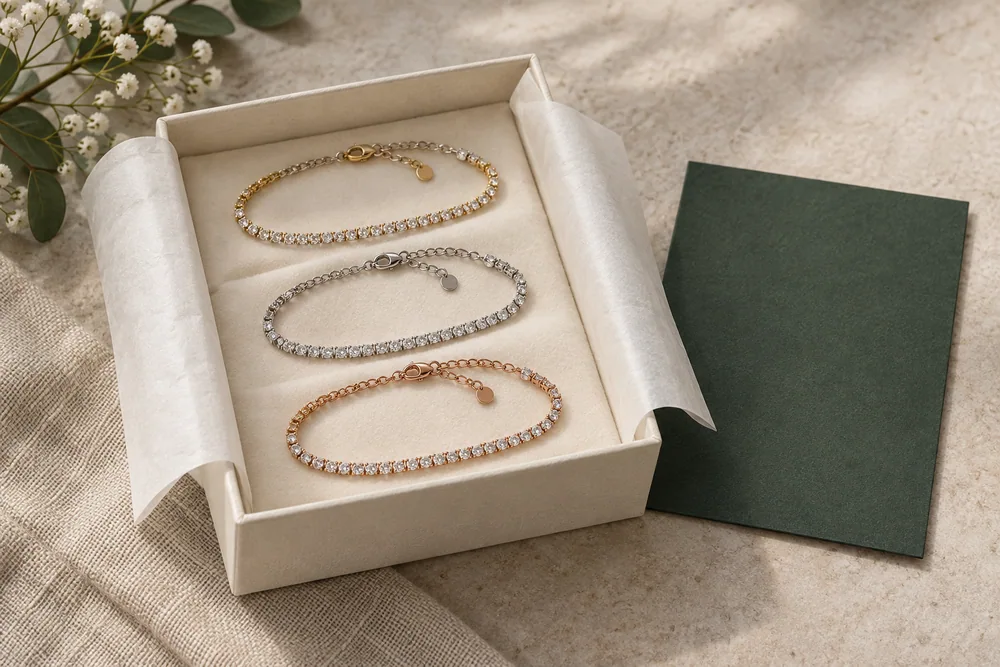
Consider a proposed gift containing three bracelets, with 80 gift sets requested. The product count is 3 × 80 = 240 bracelet pieces. If each set is boxed, the brief also calls for 80 boxes. If each set includes one printed message card, the card count is 80. Any spares belong in a separate line.
Now compare a loose assortment with 80 pieces of each of three colors: it also contains 240 bracelets, but it does not automatically include the assembly, box or card of the fixed gift set. The same piece total can therefore represent a different packing and labor requirement. These examples explain units; they are not order minimums or quotations.
Make the presentation reviewable
Include card dimensions, copy, artwork version, labels or barcodes, protective packing and the assembly order. If some details are still open, identify them as options for discussion. A phrase such as premium gift packaging leaves too many choices unresolved to establish a clear specification.
Request a complete packed sample so the product and presentation can be reviewed together. Check whether the bracelet is held as intended, whether the recipient can remove it easily and whether each color version is identified clearly. Record changes against the same sample and artwork version.
Keep the language honest
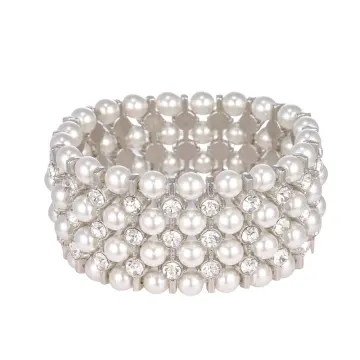
Describe the bracelet’s appearance without turning it into an unverified material claim. A silver-tone finish is not proof of sterling silver; a pearl-look element does not establish a specific pearl composition. Ask for the intended material and finish in the specification, with any required documentation appropriate to the product and destination.
Similarly, a gift message is not evidence of a charity relationship or licensed partnership. Use original or authorized artwork. If a program involves a partner, settle the permissions and the exact public wording before preparing promotional copy.
A quotation request the supplier can act on
Send the recipient and occasion, shortlisted references, requested materials and fit, color breakdown, unit contents, number of units, packaging artwork and delivery requirement in one connected brief. State the destination and required date; ask the supplier to confirm terms for that particular request.
Use the response to close the remaining decisions, then keep the approved sample and packing version available for a reorder. Clear unit definitions help both sides discuss changes: adding a companion bracelet, changing a card or switching from loose pieces to assembled sets.
Sources & scope
Source material reviewed for this article. External links are references; no affiliation or endorsement is implied. Sources were checked on 11 October 2026. Trend signals are editorial observations, not evidence of bracelet sales or market size. Event dates, access and membership terms should be confirmed with the organizer.